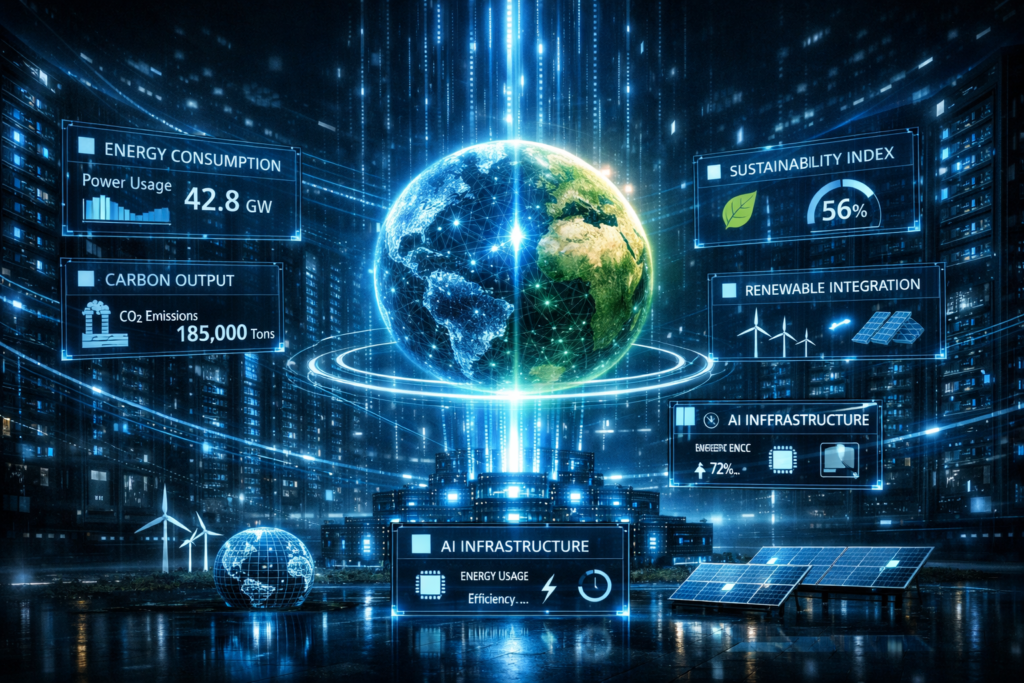
Every time you ask Claude a question, generate an AI image or use ChatGPT to write an email — electricity is consumed, water is used and carbon is potentially emitted. The environmental cost of AI is real, significant and growing faster than almost anyone expected. Here’s the honest breakdown nobody in the AI industry wants to talk about.
The Scale of the Problem
The numbers are staggering. According to Stanford’s 2026 AI Index Report AI data center power capacity has reached 29.6 gigawatts globally. That’s comparable to the entire national electricity consumption of Switzerland or Austria.
And it’s growing every single month.
Training a single large AI model can consume as much electricity as 100 average American homes use in an entire year. Running that model at scale — handling millions of user requests per day — multiplies that consumption dramatically.
The BBC recently reported that AI’s explosive growth is demanding vast amounts of electricity and energy — with new data centers being built at a pace the energy grid was never designed to handle.
The Water Problem Nobody Mentions
Electricity consumption gets most of the attention. But water usage is equally concerning and far less discussed.
AI data centers use enormous quantities of water for cooling. The servers that power AI models generate tremendous heat — and that heat has to go somewhere. Most large data centers use water cooling systems that consume millions of gallons per day.
Stanford’s 2026 AI Index estimates that GPT-4o inference water use alone may exceed the drinking water needs of 12 million people annually.
In regions already facing water scarcity — the American Southwest, parts of Europe, much of Asia — the placement of large AI data centers is becoming a genuine environmental and political controversy.
Where the Electricity Comes From
Not all electricity is equal from an environmental perspective. The carbon impact of AI depends entirely on where the power comes from.
A data center powered by solar or wind energy has a dramatically different carbon footprint than one powered by coal or natural gas. The reality in 2026 is that the grid powering most data centers is a mix of renewable and fossil fuel energy — and the balance varies enormously by location.
Amazon, Google and Microsoft have all made commitments to power their data centers with 100% renewable energy. The reality of achieving that commitment — particularly as AI demand grows faster than renewable capacity — is significantly more complicated than the press releases suggest.
The Nuclear Option
Faced with AI’s insatiable energy demands several major technology companies have turned to an unexpected solution — nuclear power.
Microsoft signed a deal to restart the Three Mile Island nuclear plant in Pennsylvania specifically to power its AI data centers. Google signed contracts with nuclear startups. Amazon is investing in small modular reactors — a new generation of smaller nuclear plants that can be built closer to where the energy is needed.
Nuclear power produces no carbon emissions during operation and runs 24 hours a day regardless of weather — making it attractive for data centers that need constant reliable power.
This has created a fascinating dynamic where the technology industry is becoming one of the strongest advocates for nuclear energy — a position that cuts across traditional political lines.
The Ocean Solution
The infrastructure challenge is so significant that some companies are looking at genuinely unconventional solutions.
Panthalassa — a startup that gained attention this week — is building data centers in the ocean. Powered by wave energy and cooled by seawater the concept aims to bypass the land and power constraints that are increasingly limiting conventional data center expansion.
Microsoft previously experimented with underwater data centers through Project Natick — submerging sealed server pods on the ocean floor and finding that the cool stable underwater environment actually improved server reliability.
Whether ocean data centers become mainstream remains to be seen — but the fact that serious companies are pursuing these solutions illustrates how acute the infrastructure challenge has become.
What the AI Industry Is Doing
To be fair the AI industry is aware of the problem and actively working on solutions.
More efficient models — Google’s TurboQuant algorithm unveiled at ICLR 2026 significantly reduces the energy needed to run large AI models by optimizing how they process and store information. More efficient models mean less electricity per AI interaction.
Renewable energy investment — major AI companies are among the largest buyers of renewable energy certificates and are funding the construction of new solar and wind capacity.
Better cooling technology — liquid cooling systems that use significantly less water than traditional air cooling are being deployed in new data centers.
Smarter scheduling — running AI computations during periods of peak renewable energy availability reduces carbon emissions without building new infrastructure.
The UK House of Commons Science Committee has launched a formal inquiry into whether low-energy computing — including an emerging field called neuromorphic photonics — could dramatically reduce AI’s energy requirements.
The Honest Question
Here’s the question the AI industry doesn’t like to answer directly: Is the benefit of AI worth the environmental cost?
It’s genuinely complicated. AI is being used to accelerate climate research, optimize renewable energy grids, improve the efficiency of industrial processes and model climate systems with unprecedented accuracy. AI may be one of our most powerful tools for addressing climate change — while simultaneously contributing to it.
The answer almost certainly depends on how quickly the industry can transition to clean energy and how efficiently AI models can be made to run.
What’s clear is that pretending the environmental cost doesn’t exist — which much of the industry has done until recently — is no longer acceptable.
What You Can Do
As an individual AI user your impact is genuinely small compared to the systemic choices made by AI companies and governments. But awareness matters.
Support AI companies that are transparent about their environmental impact and committed to clean energy. Be aware that the convenience of AI tools comes with real world costs. And stay informed — because the decisions being made right now about AI infrastructure will shape the planet’s energy consumption for decades.
The Bottom Line
AI is one of the most powerful technologies ever created. It is also one of the most energy intensive. Both things are true simultaneously.
The industry is working on solutions — more efficient models, renewable energy, nuclear power, even ocean data centers. Whether those solutions scale fast enough to match AI’s explosive growth is one of the defining environmental questions of our era.
At UntappedAI we believe in honest conversations about AI — including the difficult ones. The environmental cost of AI is real and it deserves to be part of every conversation about AI’s future.
Disclaimer: Energy and water consumption figures are based on publicly available research and estimates. Actual figures vary by model, data center location and energy source. This article is for informational purposes only.
Sources:
- Stanford 2026 AI Index Report — hai.stanford.edu
- BBC News AI Energy Coverage — bbc.com/news/technology
- UK House of Commons Science Committee — committees.parliament.uk
- Microsoft Project Natick — microsoft.com
- Google DeepMind Energy Research — deepmind.com