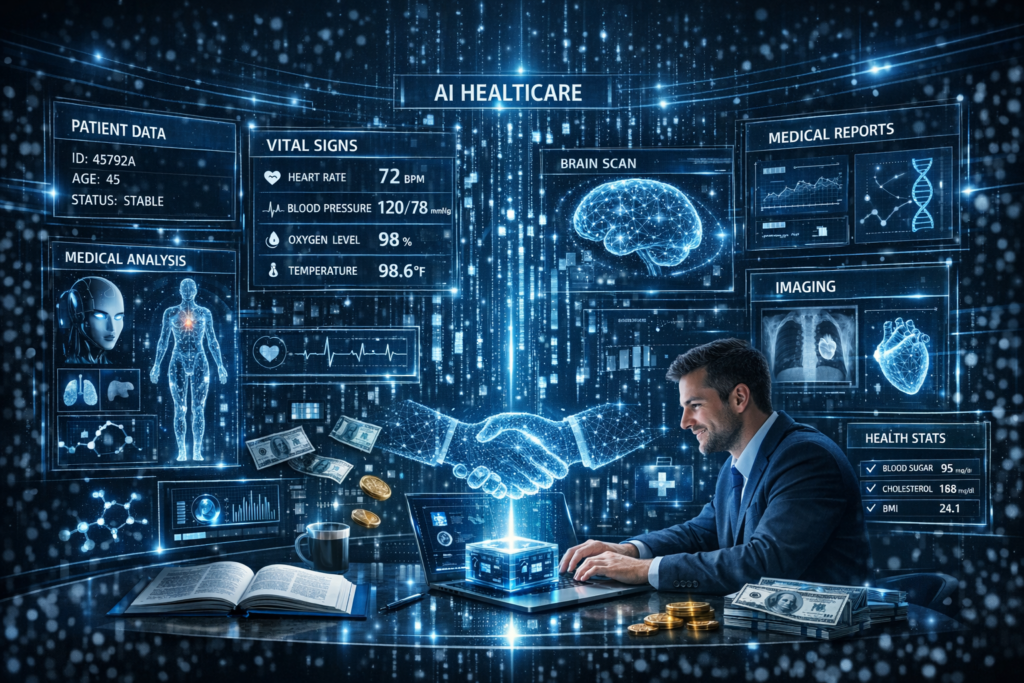
Artificial intelligence is transforming healthcare faster than almost any other industry. From diagnosing diseases to discovering new drugs AI is changing what’s possible in medicine. Here’s what’s actually happening and what it means for you.
AI Is Getting Better at Diagnosing Diseases Than Doctors
This is not an exaggeration. In multiple studies AI systems have outperformed experienced doctors at diagnosing specific conditions from medical images.
Google’s AI detected breast cancer more accurately than radiologists in a landmark study. AI systems are diagnosing diabetic retinopathy — a leading cause of blindness — from eye scans with remarkable accuracy. Skin cancer detection AI matches or exceeds dermatologist accuracy in controlled studies.
What this means for you: AI won’t replace your doctor but your doctor will increasingly use AI tools to make more accurate diagnoses. This is genuinely good news — more accuracy means better outcomes.
Drug Discovery Is Being Revolutionized
Developing a new drug traditionally takes 10-15 years and costs over $1 billion. AI is dramatically accelerating this process.
DeepMind’s AlphaFold solved one of biology’s greatest challenges — predicting how proteins fold. This breakthrough is accelerating drug discovery across thousands of diseases simultaneously.
AI systems are now screening millions of potential drug compounds in days rather than years. Several AI discovered drugs are already in clinical trials in 2026.
What this means for you: Treatments for diseases that have resisted traditional drug development may arrive significantly faster because of AI. Conditions like Alzheimer’s, certain cancers and rare genetic diseases are all being targeted with AI accelerated research.
AI Is Making Mental Health Support More Accessible
Mental health care has a global shortage problem. There are simply not enough therapists and psychiatrists to meet demand. AI is helping bridge that gap.
AI powered mental health apps provide 24/7 support, cognitive behavioral therapy exercises and mood tracking. While they don’t replace professional therapy they provide meaningful support between sessions and for people who can’t access traditional care.
What this means for you: If you or someone you know struggles to access mental health support AI tools can provide genuine help. They’re not a replacement for professional care but they’re a meaningful supplement.
Personalized Medicine Is Becoming Reality
One of the biggest problems in medicine is that treatments are designed for the average patient — but there is no average patient. Everyone’s biology is different.
AI is enabling truly personalized medicine by analyzing your genetic data, lifestyle factors and medical history to recommend treatments specifically optimized for you.
Cancer treatment is leading this revolution. AI systems analyze tumor genetics to recommend which specific treatments are most likely to work for each individual patient rather than following generic protocols.
What this means for you: Medicine is moving from one size fits all to one size fits one. This shift will save lives and reduce the trial and error that currently characterizes many treatment approaches.
AI Is Transforming Hospital Operations
Beyond clinical care AI is making hospitals more efficient in ways that directly improve patient outcomes.
AI systems predict which patients are at risk of deteriorating before obvious symptoms appear — allowing earlier intervention. Hospital scheduling AI reduces wait times and optimizes staff allocation. AI powered administrative tools reduce paperwork burden on doctors — giving them more time for actual patient care.
What this means for you: Hospitals using AI are becoming faster, more efficient and better at catching problems early. As these systems become standard the quality of care improves for everyone.
The Concerns Worth Understanding
AI in healthcare raises legitimate concerns that are worth understanding.
Data privacy is the biggest issue. AI systems need vast amounts of patient data to work effectively. Who controls that data and how it’s protected matters enormously.
Algorithmic bias is real. If AI systems are trained on data that doesn’t represent all patient populations they may perform better for some groups than others. This is an active area of research and regulation.
The human element matters. Medicine is not just about diagnosis and treatment — it’s about human connection, context and judgment. The best healthcare in 2026 combines AI capability with human compassion.
What’s Coming Next
The next five years in AI healthcare will bring:
Continuous health monitoring — wearables that use AI to detect health problems before symptoms appear.
AI surgical assistants — robotic surgery systems with AI guidance that improve precision beyond human capability alone.
Drug personalization — AI that optimizes your medication doses in real time based on how your body is responding.
Early disease detection — AI screening that catches cancer, heart disease and neurological conditions years earlier than current methods.
The Bottom Line
AI is not going to replace doctors. It’s going to make doctors significantly better at their jobs. And it’s going to make healthcare more accurate, more personalized and more accessible than ever before.
This is one area where AI hype is actually matched by real results. The changes happening in healthcare right now are genuinely extraordinary.
Stay informed about AI developments across every industry at UntappedAI — we’ll keep breaking it all down in plain English.
Disclaimer: This article is for informational purposes only and does not constitute medical advice. Always consult qualified healthcare professionals for medical decisions. AI healthcare applications mentioned are at various stages of development and regulatory approval.
Sources:
- Google Health AI research — health.google
- DeepMind AlphaFold — deepmind.com
- WHO digital health report — who.int
- MIT Technology Review health — technologyreview.com
- Nature Medicine AI studies — nature.com